BIHCA – Sodium Bicarbonate for In-Hospital Cardiac Arrest
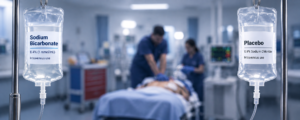
Sodium Bicarbonate for In-Hospital Cardiac Arrest
Granfeldt A. JAMA 2026; doi:10.1001/jama.2026.10628
Clinical Question
- In adults with in-hospital cardiac arrest, does sodium bicarbonate administration during arrest, improve return of spontaneous circulation, compared with placebo?
Background
- Inpatient cardiac arrest is relatively common and outcomes are poor despite the rapid provision of hospital-based advanced life support.
- Severe acidemia during cardiac arrest may impair catecholamine response, decrease myocardial contractility and worsen ischaemic brain damage, all of which may be mitigated by administration of sodium bicarbonate.
- Despite the lack of evidence, or endorsement by consensus guidelines, use of sodium bicarbonate during in-hospital cardiac arrest is common.
- RCT evidence is limited to pre-hospital data collected before the consistent implementation of modern algorithmic ALS practices.
- Previous systematic review and meta-analyses of bicarbonate in cardiac arrest have found no survival benefit or improvement in neurological outcome. However these effect estimates may be limited by inclusion of historical trials, out-hospital trial settings, and trials with late administration of bicarbonate. They may not apply to contemporary care of in-hospital cardiac arrest.
Design
- Investigator-initiated, multicentre, randomised, parallel-group, double blind, placebo-controlled, superiority trial
- Randomisation by computer generated sequence, 1:1 ratio either sodium bicarbonate or placebo in blocks of 6 without stratification
- Double blinding: Trial sodium bicarbonate and placebo in blinded kit with identical vials
- Primary analysis: modified intention-to-treat
Setting
- 21 Danish Hospitals
- Enrolment between February 6, 2023, to February 11, 2026.
Population
Inclusion:
-
- Adult patients (>18 years) with in-hospital cardiac arrest
- AND received at least 1 dose of epinephrine during cardiac arrest
Exclusion:
-
- Clinical indication for sodium bicarbonate administration
- Documented do not resuscitate order prior to arrest
- Prior enrolment in trial
- Invasive mechanical circulatory support (ECMO or LVAD)
- Known or suspected pregnancy
- Know objection to participating in the trial
- Participant numbers
-
- 2913 screened, with 372 in sodium bicarbonate arm vs 407 in placebo arm included in final analysis
- Baseline patient and arrest characteristics between bicarbonate and placebo group were well balanced:
- Age – 74 vs 73
- Known metabolic acidosis prior to arrest – 14% vs 13%
- Location
-
-
-
- Hospital ward – 62% vs 66%
- ICU – 8.9% vs 6.9%
- ED – 16% vs 16%
- Initial rhythm
- PEA – 53% vs 51%
- Asystole – 33% vs 36%
- VF – 8.1% vs 8.4%
- VT – 3.0% vs 3.9%
-
-
- Monitored arrest – 47% vs 39%
- Witnessed arrest – 76% vs 71%
- Time from arrest to adrenaline – 6min vs 5min
- Time from arrest to trial drug – 8min vs 8min
Intervention
- Administration of 8.4% sodium bicarbonate (1mmol/ml) 50ml after first dose of adrenaline or placebo (0.9% normal saline 50ml)
- Additional dose of 50ml after next dose of adrenaline if patient remained in arrest
- Maximum of 2 doses
Control
- Administration of 50ml 0.9% Normal Saline after first dose of adrenaline
- Additional dose of 50ml after next dose of adrenaline if patient remained in arrest, as per intervention arm
Management common to both groups
- Management of cardiac arrest was otherwise at clinician discretion and adhered to standardised advanced life support algorithms.
-
- Adrenaline, amiodarone and lignocaine were given in line with routine cardiac arrest management.
- Sodium bicarbonate administration outside of protocol was permitted at clinician discretion.
Outcome
- Primary outcome: sustained return of spontaneous circulation, with no need for chest compressions for at least 20 minutes
- No significant difference between sodium bicarbonate and placebo:
- 146/372 patients (39%) vs 150/407 patients (37%)
- RR 1.05 (95% CI, 0.88-1.24; p =0.62)
- Median (IQR) time to ROSC: 16 (10-21) vs 15(11-22) min
- No significant difference between sodium bicarbonate and placebo:
- Biochemical outcomes: Clear separation and physiological effect of intervention confirmed.
- First post-ROSC pH: 7.11 vs 7.03
- First post-ROSC standard bicarbonate: 17.7 vs 13.1
- Secondary outcomes:
- Survival at 30 days: 45 (12%) vs 37 (9.1%)
- Survival at 30 days with favourable neurological outcome: 30 (8.1%) vs 22 (5.4%)
- Survival at 90 days: 39 (11%) vs 33 (8.1%)
- Survival at 90 days with favourable neurological outcome: 32 (8.6%) vs 28 (6.9%)
- Mean (SD) EQ-5D-5L score (30 days): 57 (31) vs 49 (36)
- Mean (SD) EQ-5D-5L score (90 days): 77 (22) vs 64 (34)
- Subgroups: no significant difference in sustained ROSC between sodium bicarbonate and placebo.
- Age <73: 76/176 (43%) v 77/202 (38%)
- Shockable rhythm: 24/45 (53%) v 20/46 (43%)
- Known acidosis: 23/53 (43%) v 23/53 (43%)
- Time since arrest <8, min: 73/154 (47%) v 68/174 (39%)
- Witnessed: 131/284 (46%) v 122/289 (42%)
- Adverse effects: pre-specified biochemical adverse events were more common in sodium bicarbonate group.
- Alkalosis – 35% vs 20%
- Hypernatremia – 42% vs 29%
Authors’ Conclusions
- In this trial, there was no significant difference in sustained return of spontaneous circulation between adults treated with sodium bicarbonate and placebo for in-hospital cardiac arrest.
Strengths
- This is the first RCT examining sodium bicarbonate for in-hospital cardiac arrest.
- Strong methodology with multi-centre, double-blind, placebo-controlled design. Blinding and allocation concealment in this trial was a key strength, minimising treatment bias.
- Primary endpoint was objective, relevant and temporally close to intervention.
- Drug delivery was consistent and early with a median time to delivery of 8 minutes in both groups.
- There was good biochemical separation between groups.
- Long term survival and neurological outcome data was consistent and high quality.
- This trial is generalisable to adult in-hospital cardiac arrest patients requiring administration of adrenaline in high resource hospital settings with established cardiac arrest response systems.
Weaknesses
- This trial did not require documentation of intra-arrest pH as an indicator of severe acidemia, relying on pre-arrest pH and base excess to define severe acidemia (present in only 109 patients). Subgroup analysis was therefore underpowered for the group with the strongest physiological rationale for the intervention.
- The median pH post-ROSC demonstrated ongoing severe acidosis in the sodium bicarbonate group. Fixed dosing improved practicality, but may have provided inadequate dosing compared to weight based, repeated dosing or precision dosing based on pH or base excess.
- Imbalance in post-arrest interventions (PCI and ECMO) may have influenced outcome assessment, particularly long-term outcomes.
- The findings of this trial may not be generalisable to lower resource settings.
The Bottom Line
- Routine use of fixed-dose sodium bicarbonate in patients with in-hospital cardiac arrest requiring adrenaline does not improve the rates of sustained ROSC or time to ROSC.
- There may still be a role for sodium bicarbonate use in specific indications, such as sodium channel blocker poisoning and hyperkalemic arrest.
- This trial does not change my practice of not routinely using sodium bicarbonate during in-hospital cardiac arrest, unless specific clinical indications are present.
External Links
- article https://jamanetwork.com/journals/jama/fullarticle/2850405
Summary author: Jessica Ransom
Summary date: 2nd September 2026
Peer-review editor: Aniket Nadkarni