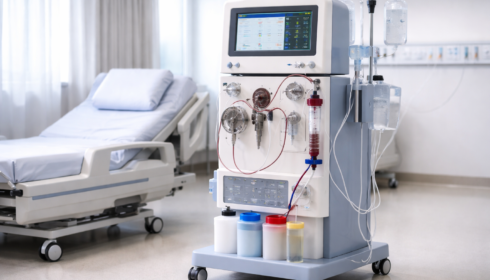
Intermittent or Continuous Renal-Replacement Therapy in Acute Kidney Injury
Intermittent or Continuous Renal-Replacement Therapy in Acute Kidney Injury
Gaudry. NEJM 2026. DOI: 10.1056/NEJMoa2608397
Clinical Question
- Among critically ill patients with AKI who had indications for RRT, is the use of intermittent haemodialysis (IHD) non-inferior to continuous renal replacement therapy (CRRT) with respect to major adverse kidney events by day 90 (MAKE90)?
Background
- AKI is associated with increased short-term mortality; increased hospital stays and long-term complications such as CKD
- Renal replacement therapy is frequently required in critically ill patients with AKI
- Classically, in the critically ill continuous RRT (CRRT) is delivered, however intermittent haemodialysis (IHD) is alternate method – this delivers dialysis in 3 to 6 hour sessions
- There is no consensus as to which method is superior with no current standardised practice
- Prior evidence largely did not show a difference in mortality between CRRT and intermittent haemodialysis
- However, these trials are outdated (>15 years ago), had small sample sizes and did not examine longer term renal outcomes
Design
- Investigator-initiated, multi-centre, open-label, randomised, non-inferiority trial
- Unblinded given nature of intervention
- Randomisation:
- 1:1 ratio into IHD and CRRT arms using web-based system with use of computer-generated, permuted block sequences
- Stratification by cumulative fluid balance and vasopressor dose
- Primary outcome: major adverse kidney events by day 90 (MAKE90)
- Death from any cause, dependence on RRT at day 90, creatinine > 25% from baseline at day 90
- Planned trial enrolment 1000 patients to provide 80% power however trial was terminated with 554 patients enrolled
- Pre-specified non – inferiority margin of 7.5%
- Assumption that event rate of MAKE90 would be 75% based on prior AKI data
- Planned testing of superiority of non-inferiority demonstrated
- Multiple imputation used for missing components of primary outcome
Setting
- 42 ICUs in France
- October 2023 to July 2025
Population
- Inclusion:
- Adults (>18 years old)
- Receiving or received invasive mechanical ventilation and/or catecholamine infusion
- At least one of:
- persistent severe hyperkalaemia (K+ > 6.5 mmol/L) despite medical treatment,
- persistent severe metabolic acidosis (pH < 7.15 with pCo2 <35 mmHg) despite medical treatment
- severe pulmonary oedema despite diuresis (P/F ratio <200, clinically overloaded)
- AKI stage 3 as defined by KDIGO guidelines with a urea > 40 mmol/L or persistence of oligo-anuria > 3 days
- Exclusion:
- Moribund state (patient likely to die within 24 hours)
- Clinician favoured one methods of RRT over another
- Advanced CKD with eGFR < 20
- Drug overdose or dialyzable toxin
- Presence or suspicion of renal obstruction, rapidly progressive glomerulonephritis, vasculitis, thrombotic microangiopathy or acute interstitial nephritis
- Previous inclusion in the study/ another trial on AKI
- Brain injured patients or other causes of increased ICP
- Subject deprived of freedom/ under a legal protective measures/ receiving state medical aid
- Pregnancy or breastfeeding
- Patient numbers:
- 1268 screened
- 554 randomised: 272 iHD and 282 CRRT
- Comparison of baseline characteristics of intermittent haemodialysis vs CRRT groups
- Age: 65.2 vs 64.1 yrs
- Female: 25.4 vs 24.0%
- BMI: 28.9 vs 28.4
- Main reason for ICU admission –
- Medical: 75.8 vs 82.1%
- Emergency surgery: 18.1 vs 9.5%
- Scheduled surgery: 6.2 vs 8.4%
- Septic shock: 46.7% vs 42.5%
- Coexisting conditions
- CKD: 21.9 vs 15.4%
- Hypertension: 51.2 vs 49.3%
- Diabetes: 26.2 vs 29.1%
- Congestive HF: 10.8 vs 11.7%
- Median time to randomisation: 3 vs 3 days
- Invasive mechanical ventilation: 84.2 vs 83.6%
- Catecholamine support: 79.2 vs 78.2%
- Indications for RRT similar:
- Hyperkalaemia: 31.5 vs 28.0%
- Acidosis: 35.8 vs 38.9%
- Oedema: 14.6 vs 10.5%
- KDGIO Stage 3, Urea >40 mmol/L: 37.7 vs 37.5%
- KDGIO Stage 3, Oligoanuria: 41.2 vs 39.3%
Intervention
- Intermittent Haemodialysis
- IHD via diffusion-based techniques
- Median duration 7 days
- Net UF: median 1.7l/day
Control
- CRRT
- Continuous venovenous haemodialysis (with diffusion-based techniques), haemofiltration (with convection-based techniques), or haemodiafiltration (with diffusion based and convection-based techniques) was used at the discretion of the treating physician
- Median duration 5 days
- Net UF: median 1.1l/day
Management common to both groups
- Investigators encouraged to follow current guidelines around metabolic control and haemodynamic stability
- Chosen technique had to be maintained for at least 4 days unless no longer clinically required (could change to different method after this); a switch after 4 days was allowed
- Switch occurred in 21.9% of IHD group (to CRRT) and 42.5% of continuous group
Outcome
- Primary outcome:
- MAKE90 occurred in 78.1% of the IHD group vs 71.6% of the CRRT group
- Adjusted RD: 6.28% (95% CI -1.22 to 13.79%)
- No difference across pre-specified subgroups (fluid balance, catecholamine support, catecholamine dose, age, sex, CKD, Sepsis, ventilation and SOFA score)
- MAKE90 occurred in 78.1% of the IHD group vs 71.6% of the CRRT group
- Secondary outcomes:
- Comparing IHD vs. CRRT group
- No significant difference in
- RRT Dependence on day 90: 2.1 vs 2.3%
- Serum Creatinine > 25% baseline at day 90: 39.4 vs 37.6%
- Median ICU length of stay: 12 vs 13 days
- Median hospital length of stay: 18 vs 22 days
- Complications similar including hypotension, cardiac rhythm disorders and hypophosphatemia
- Significantly greater in intervention group:
- Mortality: Hazard Ratio 1.30 (95% CI 1.04 to 1.63)
- Significantly less in intervention group
- Cumulative Incidence of RRT Cessation: SHR 0.77 (95% CI 0.61 to 0.97)
- Subdistribution Hazard Ratio (SHR) with death as a competing event
- Cumulative Incidence of RRT Cessation: SHR 0.77 (95% CI 0.61 to 0.97)
- No significant difference in
Authors’ Conclusions
- In critically ill patients with AKI and an indication for RRT, IHD as the initial modality was not shown to be non-inferior to CRRT for major adverse kidney events at day 90, and was associated with higher mortality
Strengths
- Central, concealed randomisation stratified by centre and by the two factors likely to affect modality choice
- Unwell population enrolled
- Limited missing data
- Rapid initiation in both arms (median 2–3 hours) following randomisation
- Low rates of protocol violations (23 excluded) with findings confirmed in per-protocol analysis
Weaknesses
- Underpowered trial due to early termination
- Whilst a difference in mortality was shown it is unclear what the pathophysiology was and therefore should be interpreted with caution
- These results should be interpreted in the context of further work looking at net ultrafiltration rates as higher rates of fluid removal have been associated with organ impairment, delayed renal recovery and mortality
- IHD dose was slightly below the recommended target (median Kt/V around 1.0), and session-level delivery data were incomplete
- Trial only addresses initial modality as allowed to switch from 4 days
- Single country may limit external validity
The Bottom Line
- iHD was not shown to be non-inferior to CRRT in ventilated/ vasopressor-dependent patients in the ICU requiring RRT with AKI
- This supports CRRT as the default first modality in unstable, critically ill patients, which is already standard practice in most ICUs but it does not tell us which modality is best once the patient stabilises
External Links
- article Intermittent or Continuous Renal-Replacement Therapy in Acute Kidney Injury
- editorial Continuous or Intermittent Renal-Replacement Therapy — What Is the Question?
Metadata
Summary author: Aneesa Patel
Summary date: 16th November 2026
Peer-review editor: George Walker
Picture by: Pexels/KaboomPics